
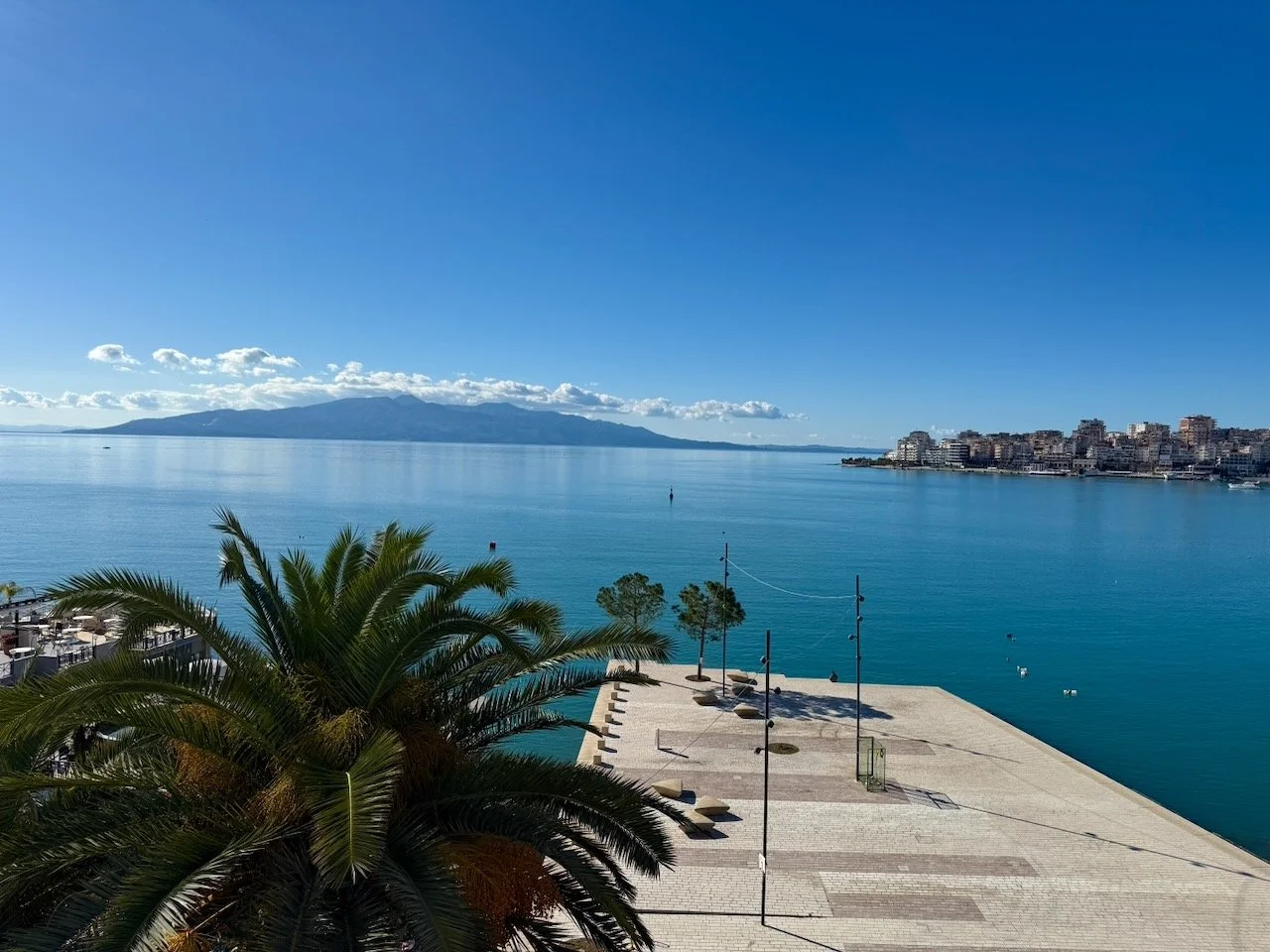
The Ionian Sea is doing what it does best: insisting on steadiness.
The sliding glass doors are streaked with salt. Sometimes I’m behind them; today I’m standing in the opening, coffee in hand. The water looks almost unreal—blue layered on blue, the surface changing its mind every few seconds as the light shifts. A gull hangs in place on the wind. A small boat draws a thin line across the glare and then disappears into it again. The day is ordinary in the way days are ordinary when you’re allowed to have them.
And still, the world is at war.
I catch myself holding my breath again—like the next update will decide whether I’m allowed to relax.
In Iran, airstrikes and a blackout turn daily life into triage. People have to figure out where to go, who they can reach, what still works. In Gaza, water, food, electricity, safe passage—things that should just be there—have been decimated. In Ukraine, sirens cut through any hope of normal. In Sudan, families face choices that should not exist: what to carry, who to help, how fast to run. In Yemen, war is not a single disaster but years of things breaking down, and civilians absorbing the cost.
I wish I could read it and stay untouched. I can’t.
Even here, it doesn’t stay “over there.” It lands in my body—tension, dread, a low-level grief that doesn’t belong to any single moment but colors all of them anyway.
And then there’s the other drift.
Alongside war, something else presses in. Democracy feels thinner at the edges. Not the kind you debate from a safe distance. The kind you feel in the air. Patience wears thin. Certainty gets louder. Suspicion passes for wisdom.
Fear does that. War does that. Hard times do that.
It’s the way conversation narrows. The way it becomes easier to say those people than to stay with the harder truth that every “those people” is a collection of individual lives, each one as specific and complicated as my own.
I feel the pull toward simplification. Toward hardness.
I’m trying not to lean with it.
WHAT MOVING BETWEEN PLACES HAS TAUGHT ME
We move twice a year now, which feels less like wandering and more like a chosen rhythm—a seasonal life, a life in chapters.
But moving at all, moving enough to be new more than once, changes your relationship to stability.
You learn how much home is made of invisible threads. Routine. Recognition. The sense of being expected somewhere. The tender mercies that let your nervous system drop its armor.
When you move often, you learn how quickly you can attach to steadiness: the market route you stop thinking about, the neighbor’s nod, the barista bringing your coffee to the table without asking because you’re a regular now.
And you learn how to live in translation—language, customs, visas, the decisions locals don’t have to make because they already belong.
My moving is chosen. That matters. But it still trains the imagination in a way I can’t undo: it’s harder to treat displacement as an abstract headline when you know—even lightly—what it costs to start again.
THE QUESTION I KEEP CIRCLING
How do I stay awake to what’s happening—without letting it harden me?
Not awake in the sense of living inside updates. Awake in the simpler sense: still able to feel, still able to see a human life as a human life, still able to resist the social drift toward cruelty-as-normal.
Because war and oppression do more than destroy places. They take safety out of the everyday. They split families, hollow routines, make ordinary errands feel like risk. And then the rest of us, watching from safety, feel the pull toward distance, toward cynicism, toward numbness.
I’m trying to resist that pull.
And I don’t want those to be my answers.
WHAT HELPS (FOR ME)
The sea helps. Not because it makes me forget, but because it widens the frame. The horizon does what it does. It keeps going.
Writing helps because it forces me to move slower than panic. It makes me choose words that are true instead of words that are sharp.
Sometimes helping looks concrete: a quiet commitment to support activism or creative work—not as a grand identity, but as a refusal to be paralyzed in every direction at once. Sometimes it looks less visible: staying careful with language, resisting the urge to flatten people into categories, remaining reachable for someone else’s grief without turning that grief into a daily ritual of despair.
Some days, the most I can do is choose one real thing and do it again tomorrow.
Mostly, what helps is returning to the human scale again and again.
Not “the conflict.” The people inside it. Ordinary life under strain.
And maybe part of why the sea steadies me is where I am. This is the other side of the Balkans’ wars, and what stays with me is how deliberately people live forward here. The proof of an “after” isn’t loud. It’s ordinary life continuing.
BACK AT THE VIEW
By late afternoon, the light changes. The sea deepens into something darker, more serious. The view looks less like a postcard and more like what it is: a vast force that has carried trade and migration and escape and grief for centuries.
I don’t have a neat ending. I don’t trust neat endings anymore.
What I have is a commitment that feels both simple and difficult:
I want to stay reachable.
Reachable to grief. Reachable to compassion. Reachable to complexity. Reachable to the truth that wars can widen and democracies can thin—and still my job is to remain human in the middle of it, not hardened into certainty, not dulled into numbness.
So I come back to the sea. I come back to language. I come back to whatever steadiness is available. Not to escape the world, but to stay in it without losing my capacity to care.
Because that capacity—quiet, durable, ordinary—might be one of the only things we can reliably carry forward.
 Ellen Barone is an American writer and wanderer. After 15 years as an independent content creator for travel and tourism, she has been enjoying extended stays abroad for the past decade, the inspiration behind her travel memoir, "I Could Live Here" (November 2023)